Membership Change Summary Report
Last updated: September 3, 2026
See your membership trends – including adds, drops, and retention over time – using the built-in Membership Change report.
The Report
At its core, the Membership Change Summary Report allows admins to analyze how membership changes over a defined time period. You can see how many members were added, dropped, renewed, and retained, view overall net and percentage changes, and compare trends over time. Results are displayed in interactive charts and detailed tables and can be exported for sharing.
The Benefits
Understand how many members joined, renewed, or dropped within a specified date range
Track overall membership growth or decline over time
Use data to inform engagement and retention strategies
Confidently answer board and leadership questions with exportable visuals and data
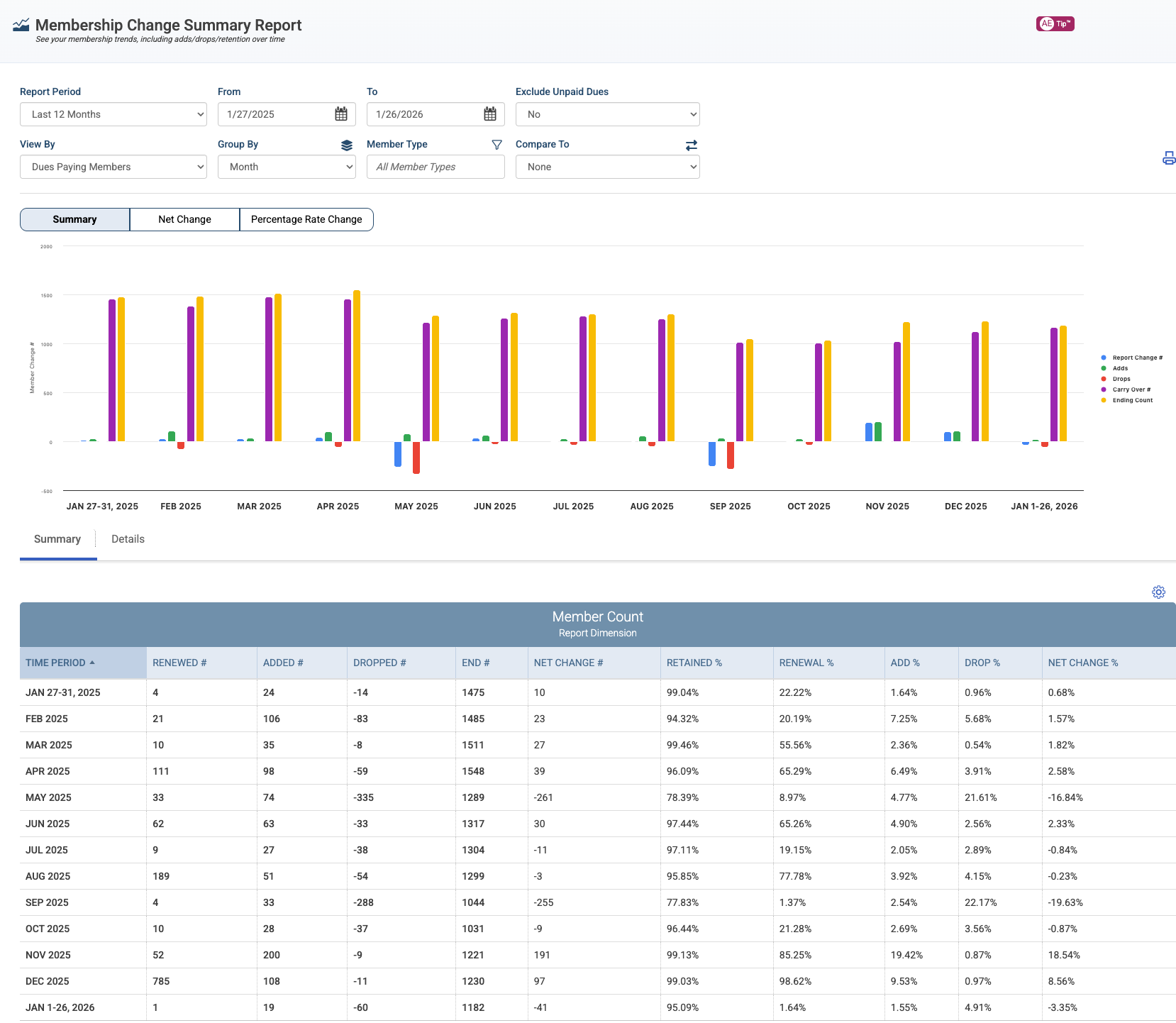
View the Membership Change Summary Report
To view the Membership Change Summary Report, navigate to Reporting> Membership Reports> and select Membership Change
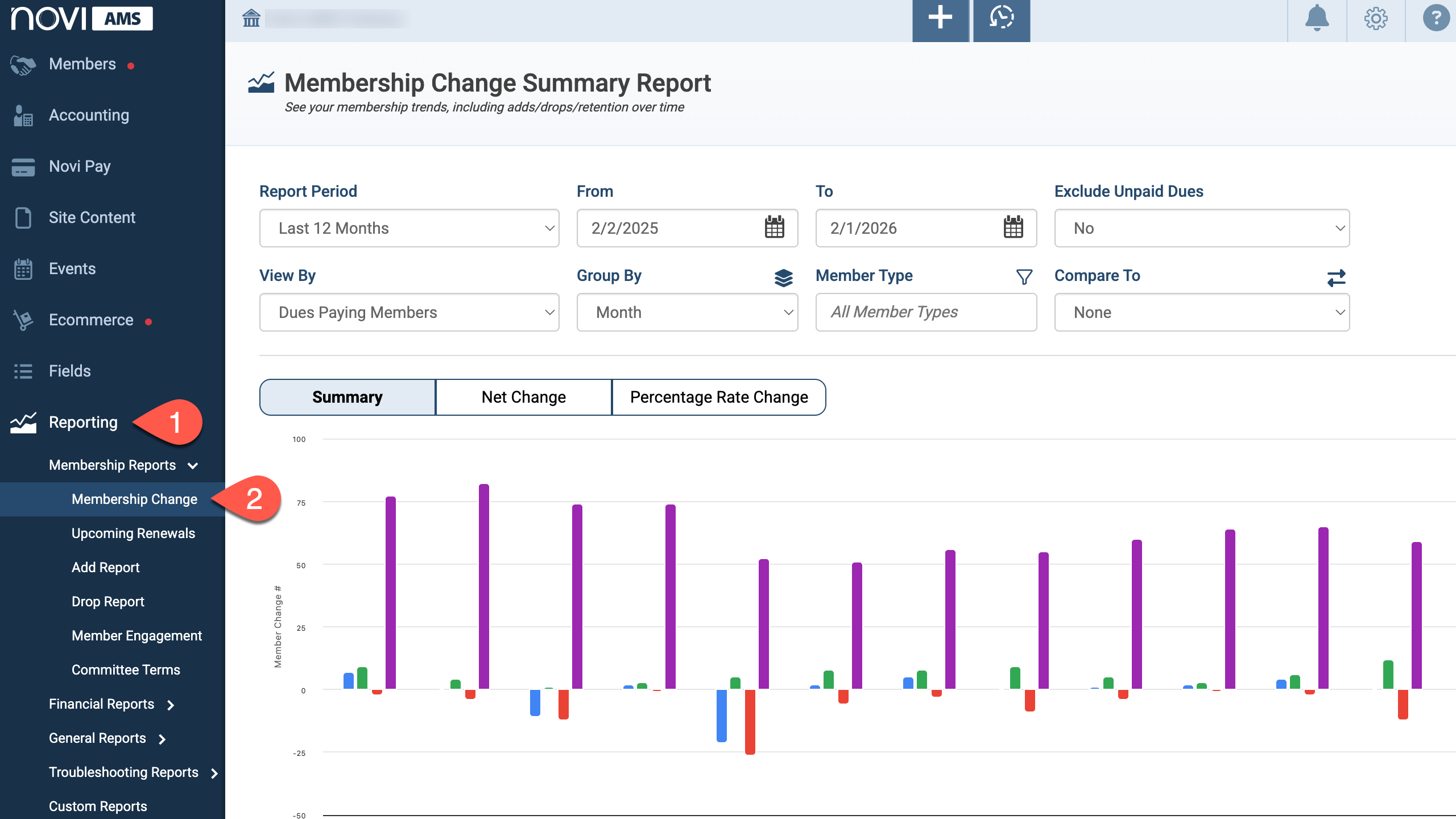
Components of the Report
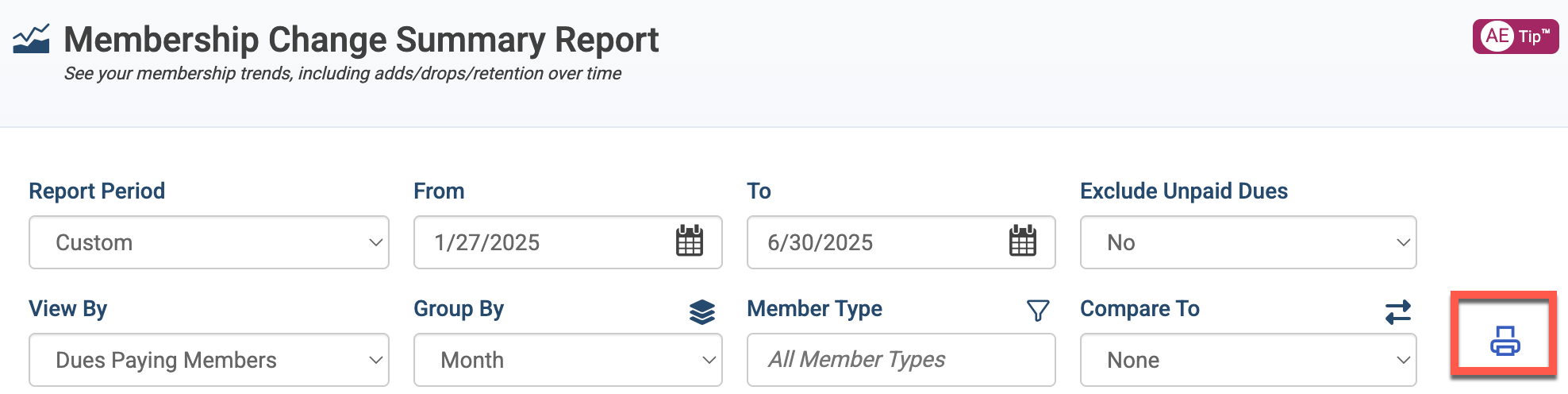
Filters – Customize the report by date range, member type, grouping, and comparison options. The report updates automatically as filters change
Chart View – A visual representation of membership activity and trends based on the selected chart view.
List View – A detailed table showing counts, percentages, and totals for each reporting period, with optional drill‑down details.
Report Filters
The following filters can be used to customize the report results:
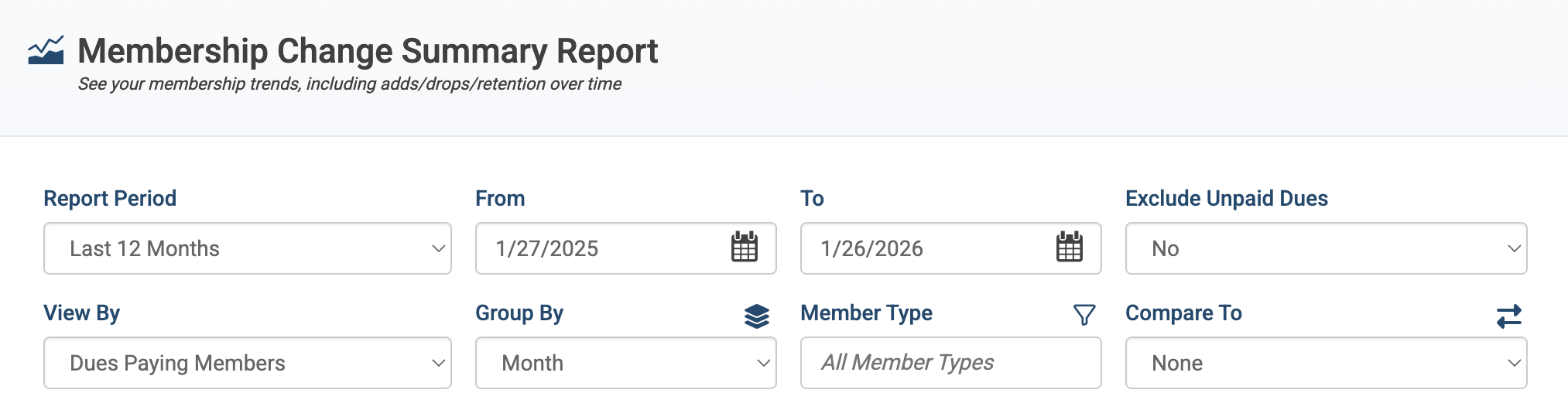
Report Period
Choose a relative date range or define a custom range.
Last 12 Months (default for anniversary‑based renewals)
Last 3 Years (default for calendar‑based renewals)
Last 5 Years
Current Year (January 1 through today)
Previous Year
Custom (select specific start and end dates)
Exclude Unpaid Dues
Filter the report based on whether membership dues were paid during the selected period.
View By
Determines which membership segment is included:
Dues Paying Members
Inheriting Members
Dues Paying & Inheriting Members
Group By
Controls how data is grouped in charts (x‑axis) and tables:
Month
Quarter
Year
Member Type
Filter results by assigned member type:
All Member Types (default)
Custom (select one or more member types)
Compare To
Compare the selected period to another timeframe (available when grouped by Month or Quarter):
None (default)
Prior Year (same period one year earlier)
Prior Period (immediately preceding period)
Chart View
The chart provides a visual summary of membership activity based on the selected filters.
Y‑Axis: Member Change (# or %)
X‑Axis: Report period (Month, Quarter, or Year)
You can switch between three chart views:
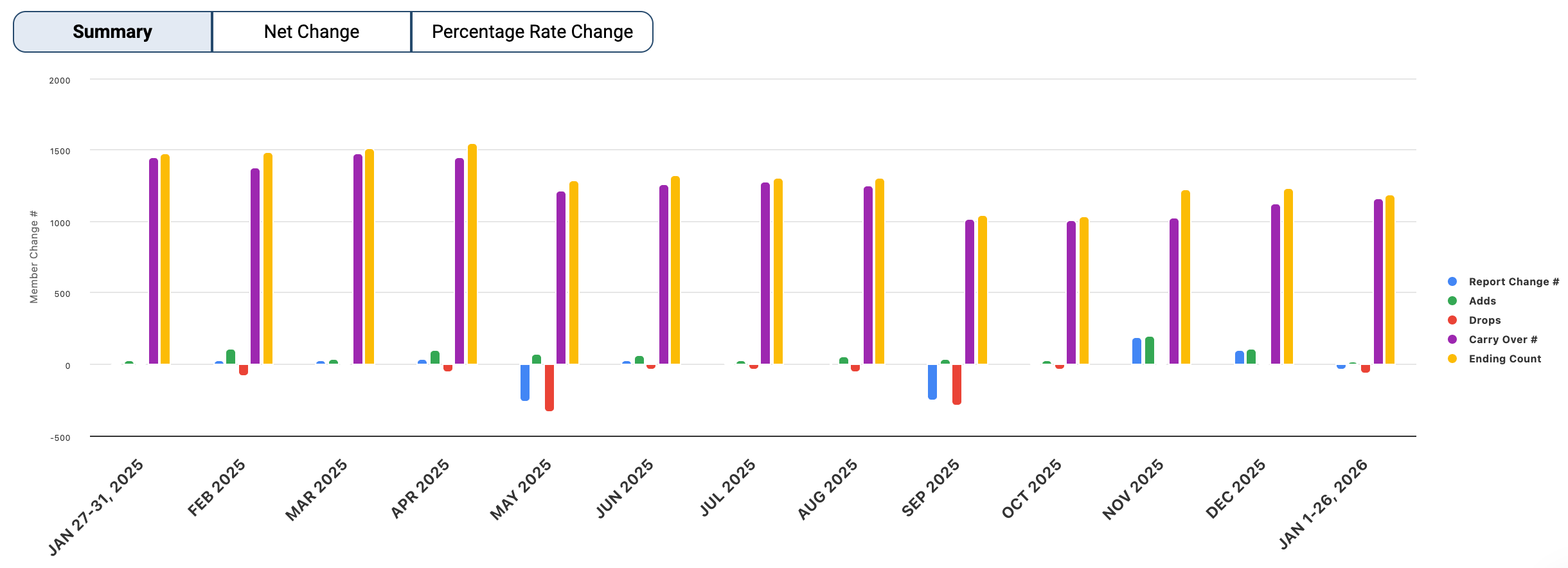
Summary Chart View
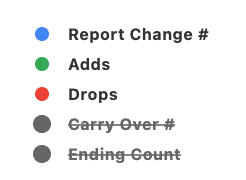
Report Change # – Difference between Adds and Drops
Adds – Members transitioning from any non‑current status to current
Drops – Members transitioning from current to any non‑current status
Carry Over # – Members who remained current during the period
Ending Count – Total current members at the end of the period
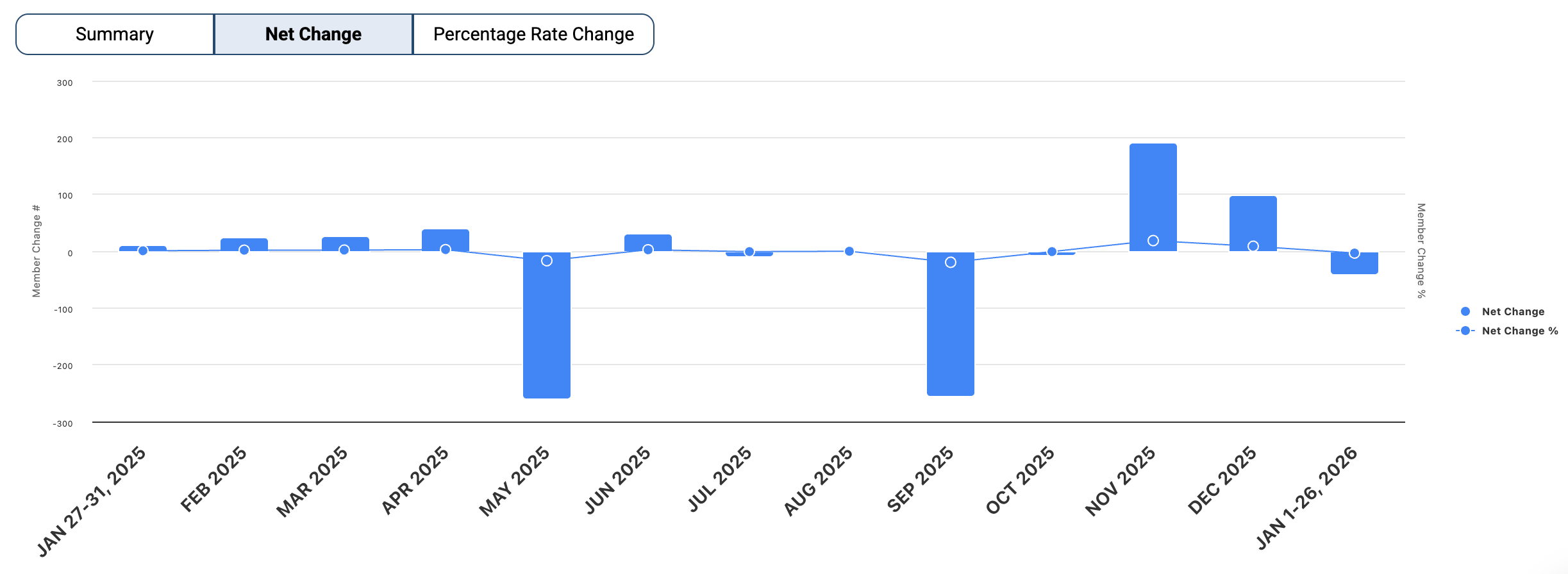
Net Change Chart View
Focuses on overall growth or decline:
Net Change # – Change in total members from start to end of period
Net Change % – Percentage change in total members over the period
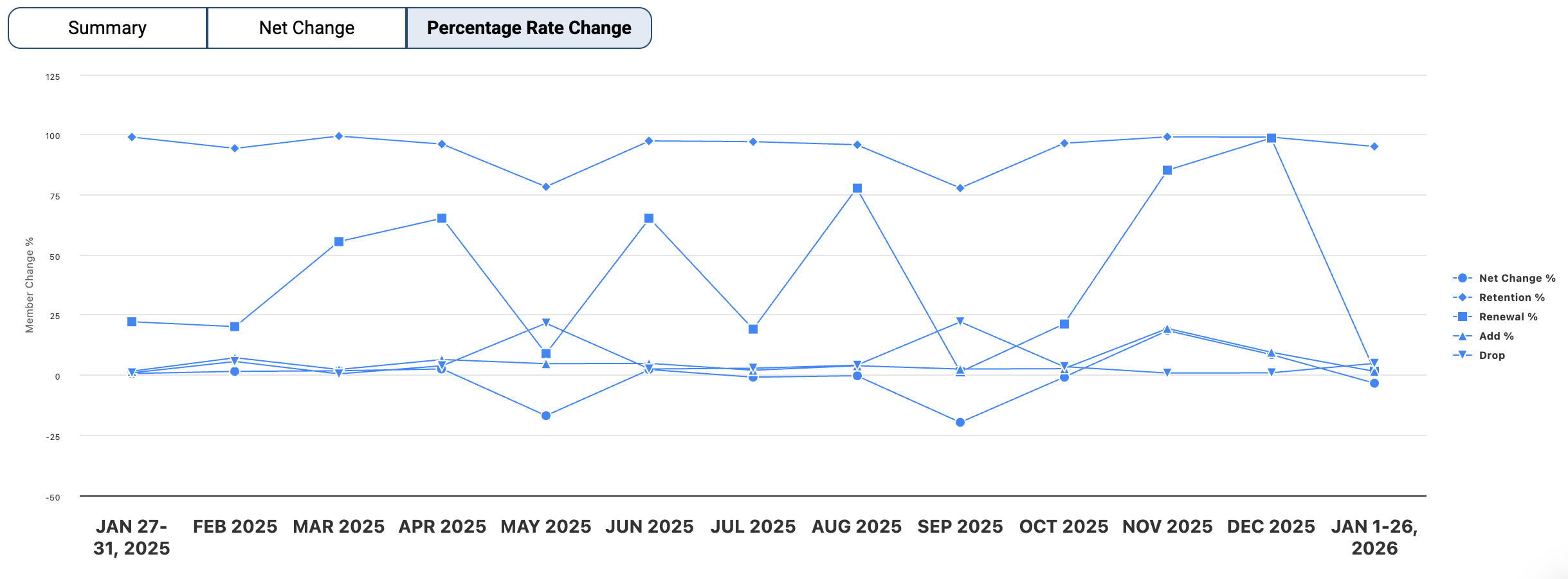
Percentage Rate Chart View
Highlights proportional trends within the specified period:
Net Change % – Overall percentage change
Retention % – Percentage of members who remained current
Renewal % – Percentage of members who renewed
Add % – Percentage of members added
Drop % – Percentage of members dropped
Click the values in the chart legend to show or hide individual data points on the chart view. Hidden values in the chart view will appear crossed out:
Summary List View
The summary table displays overall metrics for each reporting period:
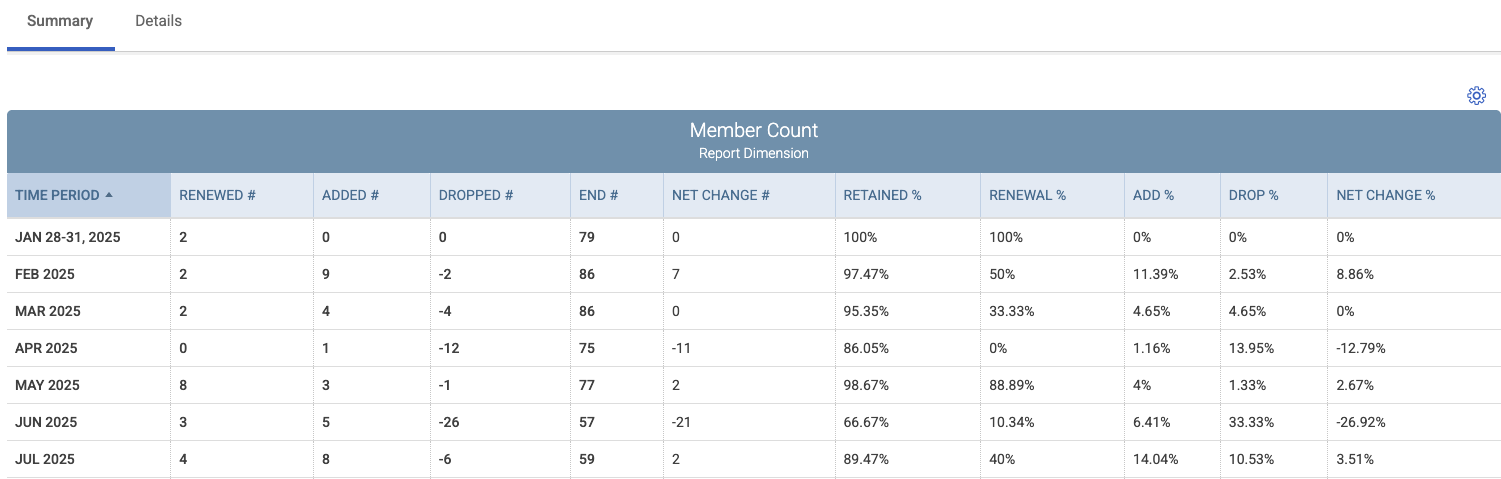
Time Period – Grouped by month, quarter, or year
Renewed # – The number of members renewed within the period
Added # – The number of members that transitioned from any non-current status to current within the period
Dropped # – The number of members that transitioned from current to any non-current status within the period
End # – The total number of current members at the end of the period
Net Change # – The difference between adds and drops at the end of the period (adds minus drops)
Retained % – The percentage of members that remained current throughout the period
Renewal % – The percentage of members that renewed within the period
Add % – The percentage of members that transitioned from any non-current status to current within the period
Drop % – The percentage of members that transitioned from current to any non-current status within the period
Net Change % – The overall percentage change in membership within the period
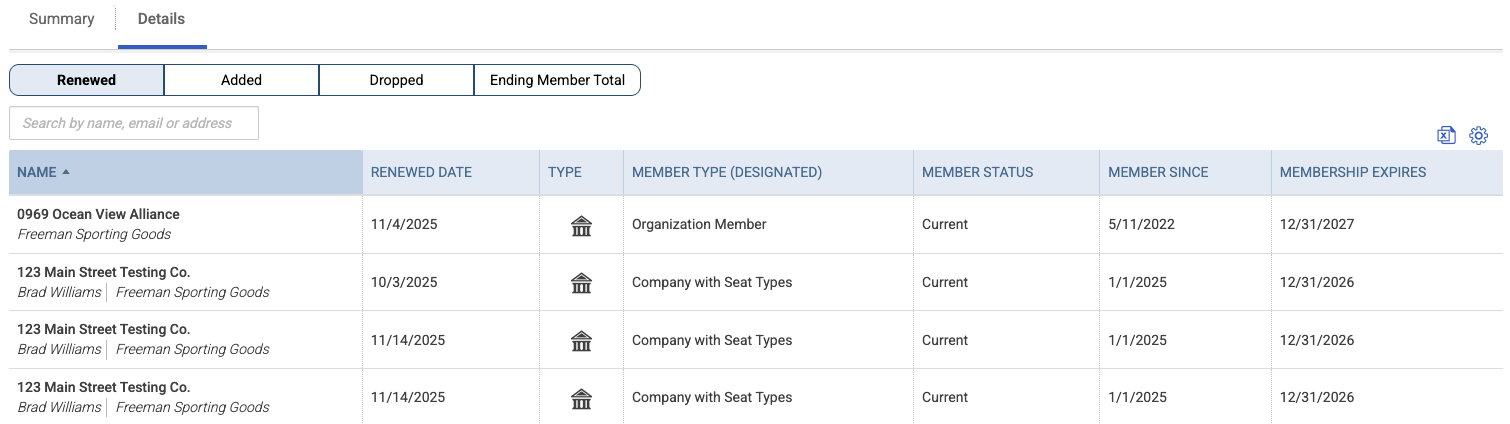
Details List View
Switch to the details list view to see which member records changed during the period:
Renewed – Members who renewed during the period
Added – Members added during the period
Dropped – Members dropped during the period
Ending Member Total – All current members at the end of the period
How the Numbers Are Calculated
The columns in this report fall into two types: snapshots (a head count at one point in time) and events (activity that occurred during the period). Understanding the difference helps explain why Start # + Added # − Dropped # doesn't always equal End #
📌 Important Note: The calculations below reference the Start #. This is a baseline for percentages for the example, you'll see it in the table as the Previous Period's End #.
Here's a walkthrough using membership data as an example, starting with 744 members:
Value | How It's Determined | |
Start # | 744 | Previous period's End # (a snapshot carried forward) |
Renewed # | 141 | Members whose status went from Current/Grace → Current/Grace via a Novi renewal event |
Added # | 4 | Members who moved into Current/Grace from any other status |
Dropped # | 18 | Members who moved out of Current/Grace to any other status |
End # | 731 | Head count of active members on the last day of the period (a fresh snapshot) |
Net Change # | −14 | Added − Dropped → 4 − 18 = −14 |
Retained # | 727 | Members at the End who weren't brand new. |
Retained % | 97.58% | Retained # ÷ Start # → 727 ÷ 744 = 97.58% |
Renewal % | 88.68% | Of the members who faced a renewal decision, how many renewed? |
Add % | 0.54% | Added # ÷ Start # → 4 ÷ 744 = 0.54% |
Drop % | 2.42% | Dropped # ÷ Start # → 18 ÷ 744 = 2.42% |
Net Change % | −1.75% | Net Change # ÷ Start # → −14 ÷ 744 = −1.75% |
📌 Important Note: Renewal % vs. Retained % answer different questions. Retained % asks "of everyone I started with, what share am I keeping?" Renewal % asks "of the members who faced a renewal decision this period, what share actually renewed (vs. dropped)?" Both are useful – they just measure different things.
Why Start + Added − Dropped ≠ End
End # is an independent snapshot – it's a head count of active members taken on the last day of the period, regardless of what happened during the month. The event columns (Added, Dropped) count every status change that occurred during the period, so one member can appear in multiple columns.
Using the above example: Start was 744 (previous period's end #), Added was 4, and Dropped was 18, which would suggest an End # of 730 – but the actual End # is 731. That one-member difference is a normal result of how the two data types work together. A few things that can cause this:
A member drops and rejoins in the same period which counts as both a Drop and an Add, but appear once in the End snapshot
A member is included in the Start snapshot but excluded from event tracking by the Exclude Unpaid Dues filter
Exporting the Report
After setting the filters, the report can be printed or exported to PDF/Excel.
Print or save as PDF by clicking the printer icon to the right of the filters. This will print/export the current chart view and the currently displayed list view:
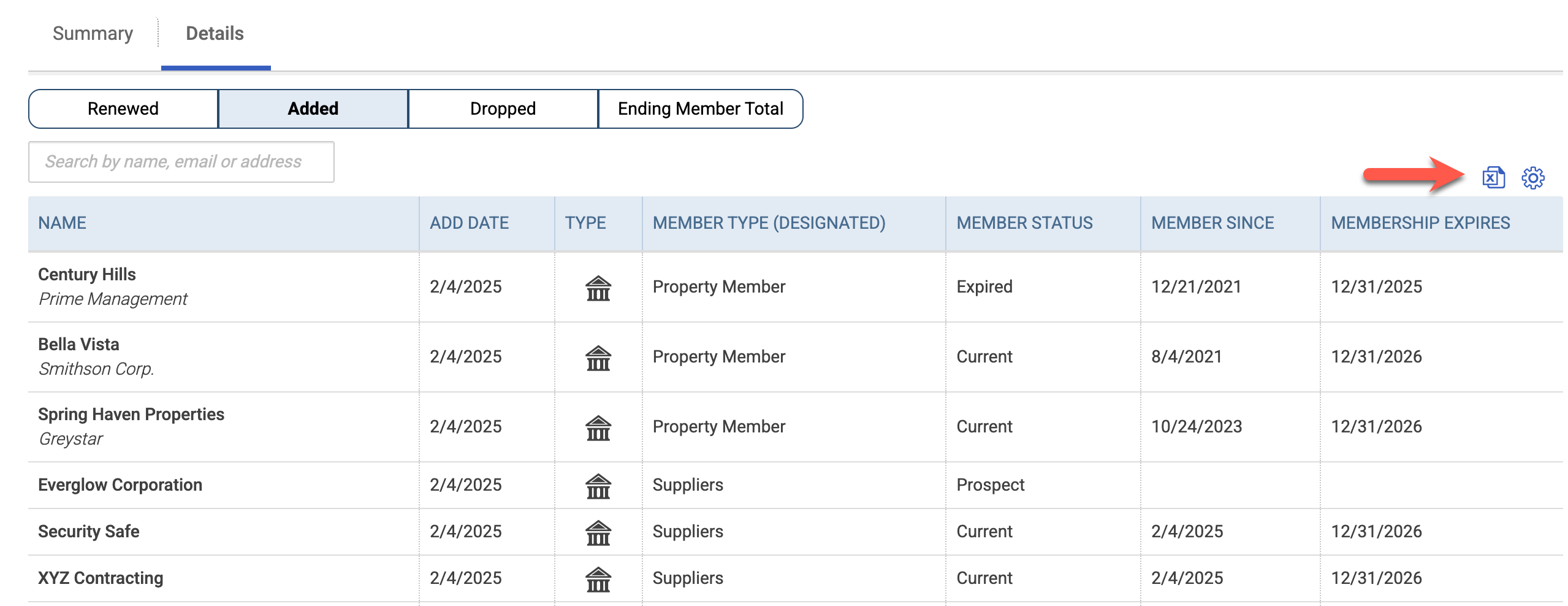
You can also export the Details list view below the chart by clicking the Excel icon:
Important Notes
Deactivating a Current member's record or removing their membership dates manually will show in the report as a drop.
This report relies on the data in your members' Activity Timelines. This data only extends as far back as your launch with Novi. Activity prior to April 2020 when the timeline feature was released may be reconstructed from audit logs and could be less precise.
Deleting a member type does not affect historical results, as the report is based on timeline activity.